books
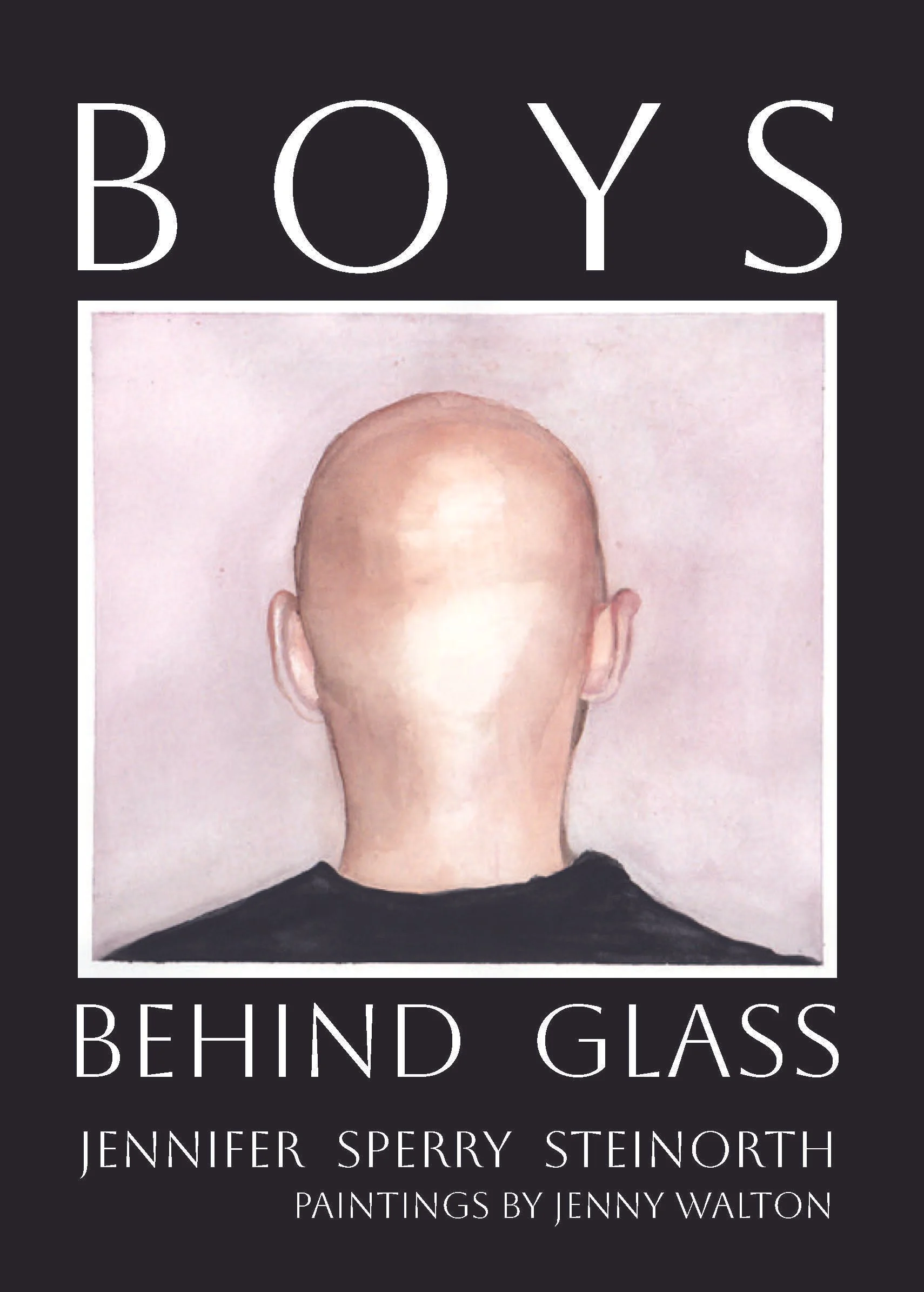
Boys Behind Glass…
is a mind-blowing experiment in form and lyric. Any of the book’s elements would be compelling on their own: Jenny Walton’s subtly sympathetic watercolor portraits of men on an online dating service; Jennifer Sperry Steinorth’s playful, incisive, rueful poems in response to these examples of the male self-gaze; and Steinorth’s ingenious sequence of asterisks-within-footnotes-within-glosses that provides an almost novelistic excavation of both a poetic persona and a culture. Altogether the reader’s experience is prismatic and mosaical as poet and painter investigate with word and image our fear of being seen and our need to be loved.
Dan O’Brien
“Some books you meet and forget their names. Some books you meet and recognize their faces. Some books, this book, you meet and know you’ll never encounter another like it again…” The Rumpus
Boys Behind Glass achieves the type of transcendence one hopes for in ekphrastic work….Through plucky language play & an eye for the absurd, this collection explores masculinity, hero worship & intimacy in the age of porn. What’s more the wit within the collection serves as a powerful counterpoint to our epoch’s epidemic of loneliness. Boys Behind Glass is truly a tour de force! ~ Charlotte Pence
An amazing project: ingenious, droll, dark, generous, fascinating, feminist in a way that understands the assignment—that is, to assume power rather than resent its lack, a female gaze on the male gaze, with all the complications that involves. Jennifer Sperry Steinorth’s poems and Jenny Walton’s paintings nod to tradition while disrupting those traditions, and bring new news about the intimacies and distances between men and women, all while being good, serious fun. ~ Daisy Fried
Part exhibition, part poetry collection, part scholarly writing, but also, so much more, Boys Behind Glass left me exhilarated by the possibility & power of ekphrasis. We experience shamelessness & shame, anonymity & intimacy, the whimsical & the terrifying. Novel, complex & brilliant, this book reclaims the reigns of what is pushed to us by algorithms & patriarchy, a rich dimensional whole from its impressive parts. ~ Ananda Lima
The pairing of Walton’s watercolor portraits with Steinorth’s sonnet-songs & cheval mirror “end notes” tilt our point of observation until we are finally allowed to move beyond the question of if there were a face to face / would it turn away? The answer is an exploration of intimacy as antidote to performance, by way of poems that converse, play, startle & dazzle with their ability to truly see. ~ Keetje Kuipers
“Here’s the dirt the heart wants the pain it knows. There are so many intricate, reflective layers to wonder and worry about in Boys Behind Glass…a brilliant book form that invites us to consider carefully the thrall and trepidation of potential love, lust, loss, lies… In these poems, the veil between humorous & serious is as slight as a camera’s lens. Impressive range & incisive specificity mark this book’s bespoke ekphrastic conversation & wily relationship to notation. The personal & political stakes stay high. We do doubletakes at Dante, Darwin, the original Walkman™ & Superman as we consider the violence & mess of masculinities. I’m haunted & enhanced by the many rabbit holes this book looks down. Forget/what you think you know about double exposure, but be careful: every pairing is a beginning…” Aaron Coleman
“Boys Behind Glass opens a door hidden behind a mirror—& I fell straight through. Part lookbook, part feminist archive, this weird, wise, dazzling & genre-defying collaboration flips the historically male academic gaze inside out. In conversation with Jenny Walton’s haunting watercolor portrait series, Match/Enemy, Jennifer Sperry Steinorth sifts through fragmented narratives to uncover the complexities of testimony, embodied trauma, justice, and complicity. Where silence & spectacle have long shielded power, this book holds its provocative glare. Ok, Archaic Torso of Apollo—I see you.” Jenny Molberg
In Boys Behind Glass, Jennifer Sperry Steinorth’s poetry & Jenny Walton’s paintings entwine to explore the fractured terrain of modern intimacy. Throughout these poems, Steinorth delves into modern romance with a magnifying glass, digging deep to hold up portraits of loneliness & to offer glimpses of the inner lives of men in dating apps, men with concealed faces, half-faced, faceless. “The problem w/ love is it’s // never known better,” Steinorth writes, & it is this problem that Steinorth confronts so brilliantly, blurring the line between watching & being watched, between performative & informative text. Via endnotes, which are open windows for us to see the poems’ blood & marrow, Steinorth creates a secondary voice that adds dimension to the poetic & the visual, intensifying our understanding of the contradictions of desire & connection in a digital age. ~ Octavio Quintanilla

AWARDS
Foreword Reviews Bronze Prize in Poetry
Fred Whitehead Award for Design from the Texas Institute of Letters
O Mr. Read—touch me where I bleed—put your sensitive hands in the wound…
…We are
great reservoirs’…
…And this portrait—a performance, an I-refrain, casting light and shade—Baby, this is our offspring.
Her Read, A Graphic Poem TRP, 2021
“...a book of wicked elation. Enacting revelation through effacement, divination through artistry, and lyric out of transgression, Jennifer Sperry Steinorth has produced a poem that is “love suffused with iron.” Rick Barot
“So that what begins in erasure transforms, as the book goes on, into a rich, layered graphic poem…an artist’s and a builder’s and designer’s eye collaborating with a poet’s tongue, and a dancer’s knowledge of how expression begins in the body.” Eleanor Wilner
“...a weave of arrows and mazes, gashes of thread, portals, and the collaged image of a severed oracle... Radiating both harm and cure, there is nothing like this book: it is sublime, a masterpiece.” Nomi Stone
“Impish and beautiful, and dazzlingly subversive, Her Read expresses the "sacred rage" ...This is not a book of poems, it's an archeology of palimpsests, a recovery by covering, a visionary art made out of the cadaver of art criticism…” Philip Metres
“…deeply embodied and unashamed –– rendered in reds, creams, yellows, browns and organic, anatomical shapes that evoke womxn’s real bodies, labors, triumphs, horrors… Steinorth is an exorcist of the highest capability.” Jane Huffman
“…a study in desire and erotic play— amusing, troubling, beautiful, and broken. It sings the pain of our grandmothers and great-grandmothers and celebrates the beauty of mutual love... Its originality and heart leave me breathless.” Fleda Brown
AWARDS
Finalist: the Eric Hoffer Book Award
Finalist: Foreword Reviews Best of the Indie Press Prize
“Like only the finest poets, Jennifer Steinorth creates her own revelatory, slant language of the interior, one of disquieting, intimate estrangements, dailiness dispossessed of its easy familiarity, distant atrociities disconcertingly present. The action of her nuanced, unsettling, multivalent lines resembles the wisteria vine on the fixed frame: ‘the living thing/that will pull it down climbing/up…’”
— Eleanor Wilner
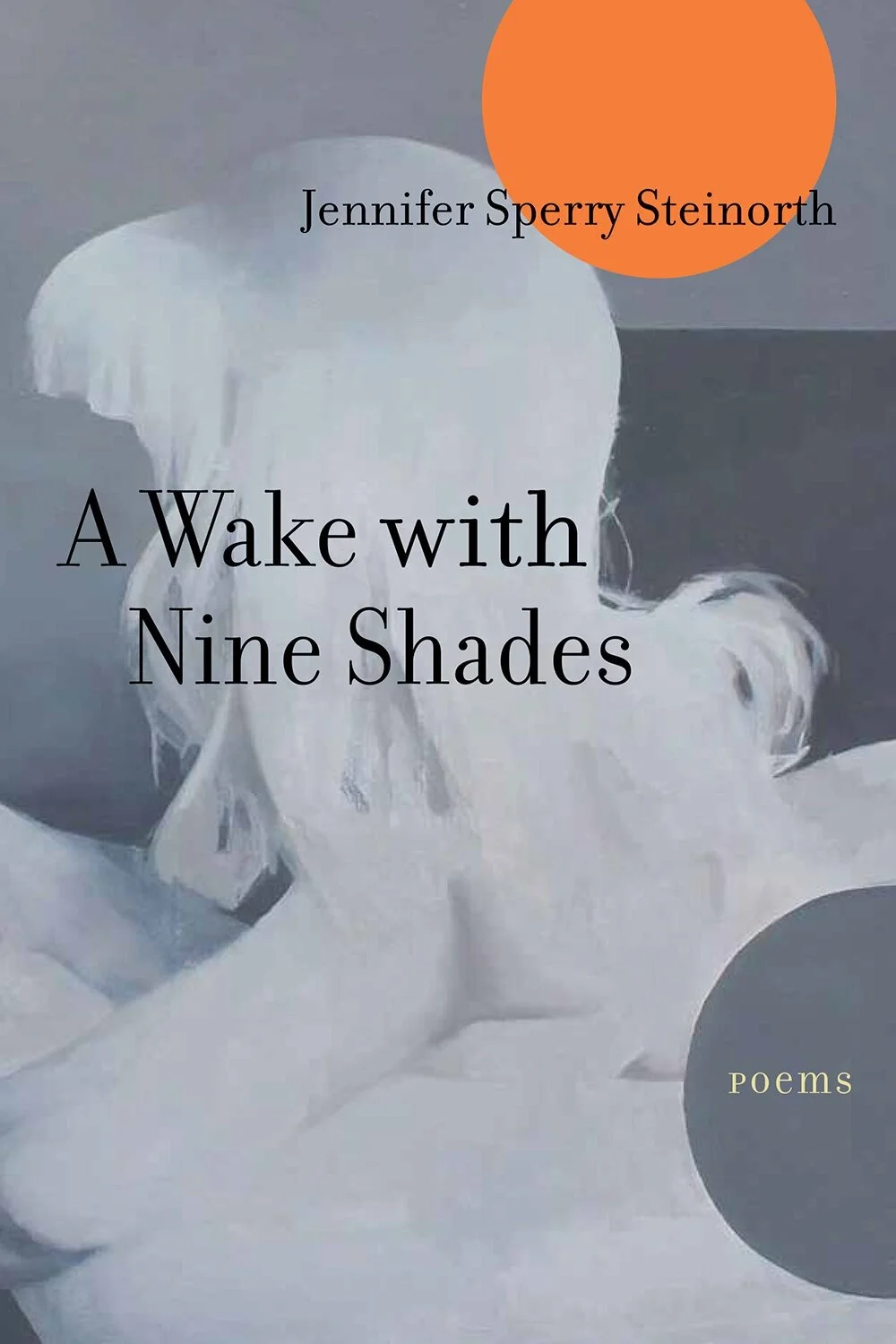
A Wake with Nine Shades*
“Although there is word-play in the title of this book and throughout its alternating brief and densely fragmented poems, the play is dark. This is a book that communicates by impression, more than expression. The impression I get is that of a dance between love and grief. The partners are locked together, bound by a locked language, a shared contrast that cannot be refused. This personal dance is also set against our dark national dance of recent and older history. Yet it’s all happening at once in a timeless blur. And there’s a present audience, who is inclined to see this dance as bitter and beautiful and unavoidable in the same glimpse. This is real and immediate poetry, presented on the page in the moment of its passionate breath. That breath belongs to the world, but it is also starkly human. Though death is a central feature of this book, the poetry is about being alive.”
— Maurice Manning
“A WAKE with NINE SHADES composes scenes built from a life that moves between the dream world of a somnabulist and the mindful actions that get us through our daily lives, “but these dreams!” Whether arguing with Robert Frost or courting his better angels, Jennifer Sperry Steinorth reveals the neglected sublime that deserves a second look. Frost becomes a metaphor for the complexity of the world we’re trying to make sense of, but she invites us to use all of it—the “hard to predict weather,” discords “together, for pleasure,” and the “cheers…through hunger”—to dream more. Indeed, A WAKE with NINE SHADES is a billet-doux to the world we still fight for and to the better world of which we dream.”
— A. Van Jordan
TRP, 2019
Black Dress
I am a cave / you want / to explore // want // to crawl on your— / with a lick of torch. // There are trunks full / of gold, jewels— // You are sure // You have been drinking // fairy tales. I told you / what you would find / in the dark wet— / skin // and bones— // the skeleton / of a hero / from some other / search party // and these / exquisite / hand-forged / hand cuffs.
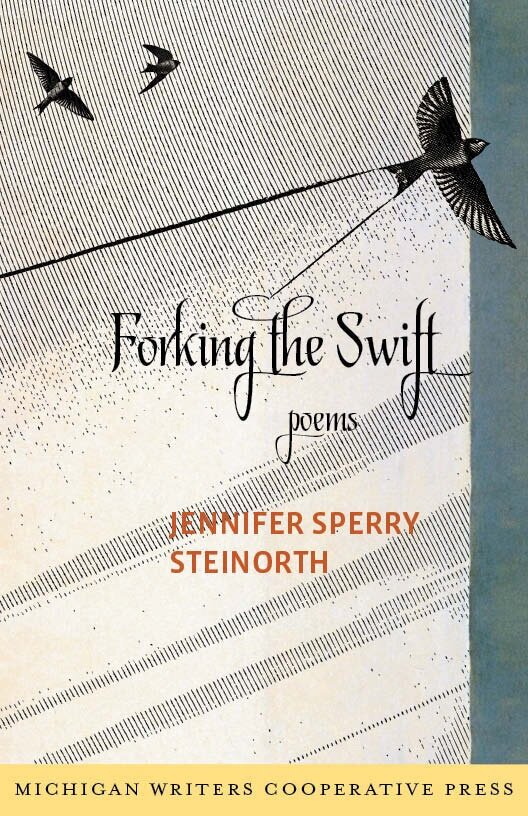
Forking the Swift
“Among the many striking rewards of Jennifer Sperry Steinorth’s Forking the Swift is being led into the startling realization that everything is a wilderness. She leaves us alone and lost with no guide except the poem. When we stumble out from her work, we wonder how we survived and we learn that survival means changing into something new. Notice how she makes form evoke and embody what the language explores. This is artistry that matters and means. These poems put the lie to one ever again saying, “Seen that. Done that.” Steinorth brings us back to the enigmatic wonder of it ALL.”
— Jack Ridl
“In a world where language may be as homogenized as milk or as pretentious as Jello colors, Jen Sperry Steinorth’s poems offer the essential-ness that a long look at a clear night sky will give you. She is as attentive to sound as a jazz trumpeter is, “Those Triassic Calamites out a coal mine in Tasmania...,” letting the mutes and sibilants move in and out of a poem like fireflies, but she’s also as grounded and authentic as a good drummer: climbing oil rigs, going for smokes, and yes, what about that black dress? Her poems range wide in refreshing content and format, strung with phone calls from the electrician and wrestling bears. They are permeated with quiet wit about human and wild nature—think of “Thirteen Ways to Kill Starlings.” Without sentiment or cliché, Jen brings us what we love in poetry, the song of shaped sounds rivering through shaped meaning—“suck the marrow/the morrow.” Michigan Writers is proud to introduce this dynamic work not just to lovers of poetry, but to all of us who long for a clear eye to show us the what shines in the dark. ”
— Anne-Marie Oomen
Michigan Writers Cooperative Press, 2010